

Exit Holes
Small holes in the bark where adults have emerged. Depending on the species, holes may be round, oval, or D-shaped.
Tree borers are among the most destructive problems a tree can face. Since the larvae feed beneath the bark, damage is often hidden until it's too late.
“Borers” refers to a group of beetles and moths whose larvae live inside trunks, branches, or roots. They are difficult to spot early because most of the damage happens under the bark.
Borer larvae tunnel into the cambium, disrupting the movement of water and nutrients through the tree. Heavy infestations can weaken, girdle, or kill a tree over time.
Borers commonly attack trees already struggling from drought, transplant shock, root stress, soil compaction, bark injury, or other underlying issues.
Not every hole, dead branch, or declining canopy means borers. Correct identification matters because treatment timing, product choice, and expectations can vary by tree species and by the specific insect involved.
Because borer larvae stay hidden beneath the bark, the best way to catch a problem early is by looking for the evidence they leave behind.
Small holes in the bark where adults have emerged. Depending on the species, holes may be round, oval, or D-shaped.

A sawdust-like material can collect in bark crevices, on limbs, or around the base of the tree as larvae feed and tunnel inside.

Some trees try to push insects out by bleeding sap or pitch from entry points. Fresh gumming or bleeding on the trunk can be an important clue.
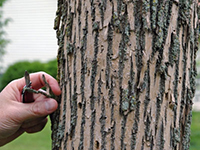
If woodpeckers are working one area of the trunk repeatedly, they may be hunting larvae beneath the bark. Bark flecking or probing can be a strong warning sign.
In addition to visible bark symptoms, trees with borer pressure often show decline in the quality of their canopy.
The borer is often not the first problem. It is commonly the result of a tree already under stress. That is why watering, mulching, root-zone care, and reducing bark injury are such a big part of tree care!
During hot, dry weather, deep watering helps maintain sap flow and supports the tree’s natural defenses.
Apply 2 to 3 inches of mulch over the root zone, but keep it pulled back from the trunk to avoid moisture buildup against the bark.
Prevent mower and weed eater damage, avoid unnecessary bark wounds, and don’t over-prune stressed trees.
If you purchased your tree from The Tree Place and it is showing signs of stress, fill out the support form and include photos of the trunk, foliage, and any holes, frass, sap, or dieback.